

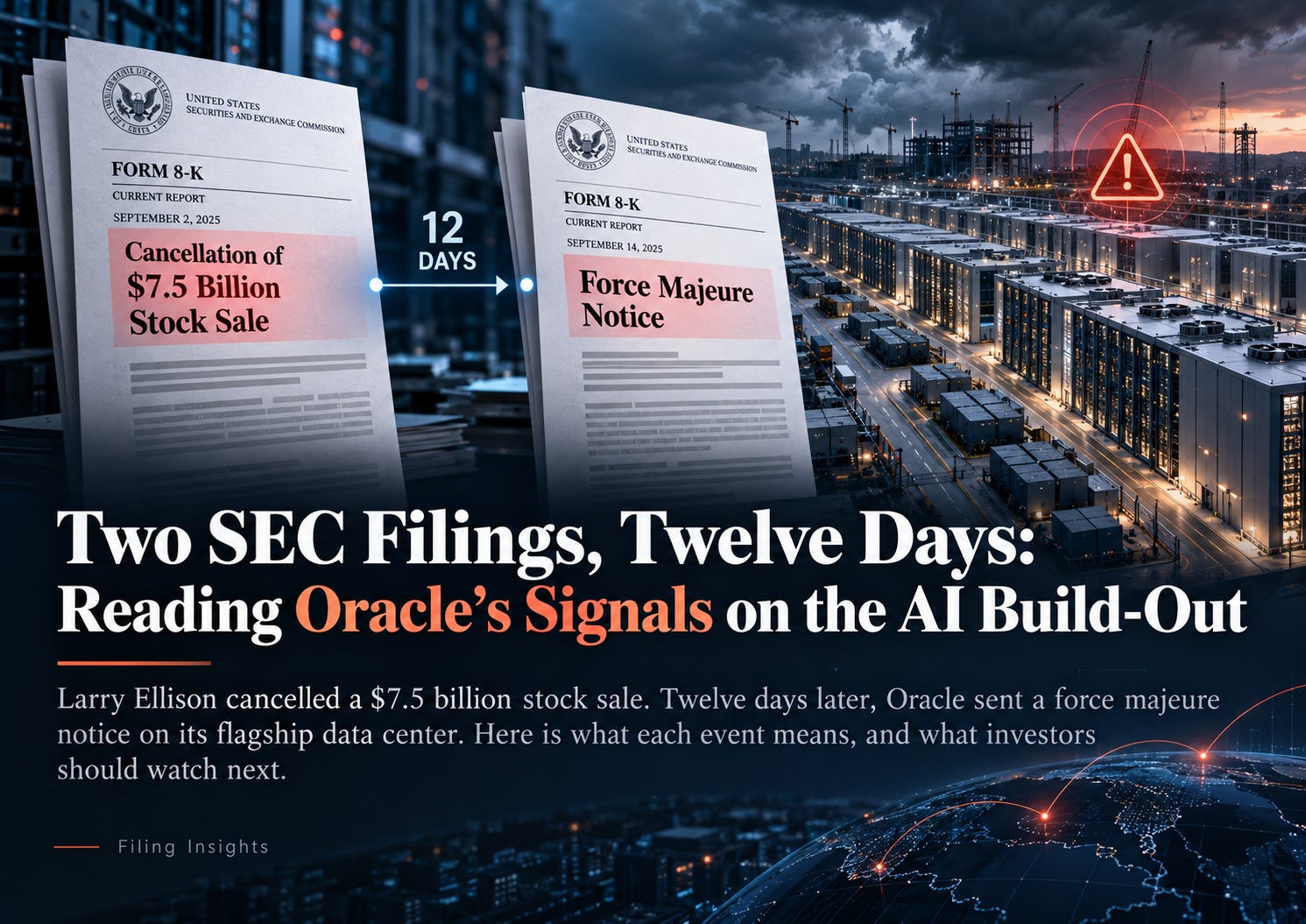
We’re hearing more and more about an AI bubble. The implications for our economy could be substantial. I’ve been checking the SEC Filings each time I see an article about one of the large AI providers or consumers. Oracle submitted an 8-K regarding the cancellation of the sale of Shares by Larry Ellison, which was disclosed in the prior 10-Q. The timing and recent Oracle force majeure makes for an interesting article. Also provides clues on which filings to watch for regarding Oracle and the AI industry overall.
TL;DR
The sale plan: Oracle’s latest 10-Q (Part II, Item 5, page 37) disclosed that Larry Ellison adopted a 10b5-1 plan on June 22 to sell up to 50 million shares, about $7.5 billion and roughly 1.7% of the company. No price condition was disclosed.
The reversal: The plan became public September 11. Ellison cancelled it the next day, sold nothing, and said he has no other plans to sell. The September 14 8-K is the only formal record of the cancellation.
Context that matters: Oracle amended its $20 billion equity sales program one day after Ellison adopted his plan and sold the full amount during the quarter. A securities class action naming Ellison over statements about the cloud business was already pending.
How to read it: A modest positive that removes a share overhang, but declining to sell is weaker evidence of conviction than buying. The more telling question, why he planned to sell in June, remains unanswered.
The force majeure notice: On September 24, Oracle notified Blue Owl’s development unit that it may defer payments if Project Jupiter, its 2.45 GW Stargate campus in New Mexico, misses its 2028 start. Denied pipeline permits, a delayed air permit, and a possible state data center moratorium are the causes.
Market signal: Credit reacted harder than equity. Jupiter loans trade around 89 to 91 cents, Oracle’s 2055 bonds near 77 cents, and Morgan Stanley warned the notice could set a precedent for other data center tenants.
The bubble question: Jupiter shows supply struggling to come online on schedule, not demand collapsing. The risk applies to every company building large-scale compute. If delays spread across sites, lenders and shareholders could feel effects similar to a deflating bubble even with demand intact.
Key dates: November 23 air permit decision, the November New Mexico election, the next 10-Q’s Item 5, and December 18 for briefing on any motion to dismiss the class action.
Oracle spent September generating headlines that point in different directions. One suggests insider confidence. The other suggests the physical build-out behind Oracle’s AI backlog is running into limits that money alone cannot solve. Read together, they offer a useful case study in how to interpret corporate disclosures during a period of heavy capital spending and rising skepticism about AI infrastructure returns.
Where the Sale Plan First Appeared: The 10-Q
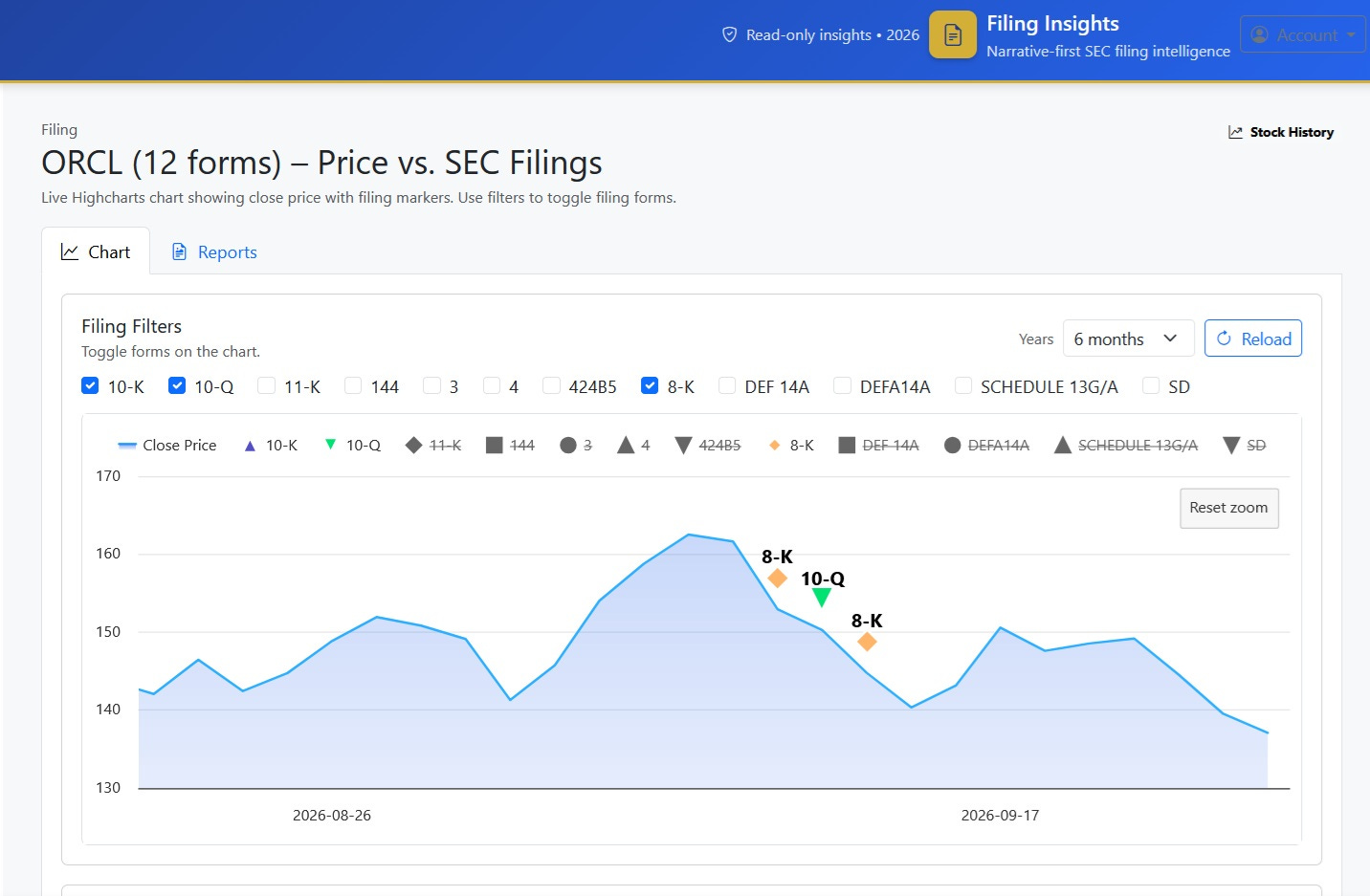
Most coverage started with the cancellation. The original disclosure is more revealing.
It sits in Oracle’s 10-Q for the quarter ended August 31, 2026, in Part II, Item 5 (”Other Information”), on page 37 under the subheading “Rule 10b5-1 Trading Plans.” After standard language noting that Section 16 officers and directors may enter plans intended to meet the affirmative defense conditions of Rule 10b5-1(c), the filing names one officer who adopted a plan during the quarter: Ellison, who adopted a new trading plan on June 22, 2026, scheduled to terminate on October 24, 2026, and intended to permit him to sell up to 50 million shares of Oracle common stock. The section adds that the plan was precleared under Oracle’s Insider Trading Policy and that any sales would appear in future Section 16 filings.
A few details stand out.
No price condition was disclosed. Other Oracle officer plans have included limit prices. An earlier 10-Q, for example, described an executive’s plan to sell up to 15,000 vested shares subject to certain limit prices. The Ellison disclosure mentions no price condition. The plan document is not public, so investors cannot confirm whether one existed, but as disclosed, the plan reads as a sale program without a stated floor.
The size is modest in share terms and large in dollars. The 10-Q reports 3,023,736,000 common shares outstanding as of September 7, 2026. Fifty million shares is roughly 1.7% of the company, worth about $7.5 billion at recent prices.
The company was selling stock at the same time. Oracle’s $20 billion at-the-market equity program was amended on June 23, 2026, one day after Ellison adopted his plan. Oracle fully used the program during the quarter, issuing 141 million shares for net proceeds of $19.9 billion. Nothing in the filing links the two, and there is no indication they were coordinated. Still, the company and its largest shareholder had both arranged to put stock into the market in the same window.
Securities litigation was already pending. The same 10-Q discloses an amended class action complaint filed July 14, 2026 against Oracle, its Chief Technology Officer, one of its CEOs, two other executives, and a board member, alleging misleading statements about the cloud infrastructure business. Ellison is the CTO. A large insider sale during active securities litigation over the same business would likely have drawn attention from plaintiffs. The filing does not say this influenced the cancellation; it is a reasonable inference, not a stated fact.
The 8-K: A Sale Registered, Then Withdrawn
The 10-Q made the plan public on September 11. Ellison cancelled it the next day, and Oracle gave no reason. On September 14, Oracle filed an 8-K containing a single substantive sentence:
“On September 12, 2026, Oracle issued a press release announcing that Larry Ellison, Executive Chair of the Board and Chief Technology Officer of Oracle Corporation (”Oracle”), has cancelled his 10b5-1 Plan to sell Oracle stock.”
The filing adds that no stock was sold under the plan before termination, and the accompanying press release states he has no other plans to sell any of his Oracle stock. Because the cancellation happened after the 10-Q was filed, the 8-K is the only formal record of it.
A one-day reversal after public disclosure reads as a response to how the plan would be received. The backdrop was difficult. Oracle has built up a heavy debt load while repositioning around AI infrastructure, and the stock had fallen roughly 23% this year. The quarter showed $28 billion in capital expenditures, negative free cash flow of $5 billion, and the completed $20 billion equity issuance. A founder who controls more than 40% of the company registering to sell billions into that environment raises an obvious question. The cancellation removed it.
What the cancellation tells you
It is a modest positive. Ellison chose to keep full exposure and made a public statement that would be awkward to walk back soon. It also removes a potential supply of 50 million shares that the market might have absorbed through October.
The limits are real. Declining to sell costs nothing in cash and carries less weight than an open-market purchase. “No other plans to sell” describes current intent and is not a binding commitment. The filings never explain why Ellison wanted to sell in June, and that original decision, whether driven by diversification, estate planning, or personal liquidity, may reveal more about his thinking than the reversal does.
There is also a regulatory consequence. Under the SEC’s 2023 amendments to Rule 10b5-1, a new plan for a director or officer carries a cooling-off period of at least 90 days before sales can begin, so near-term selling through a plan is effectively off the table.
The Force Majeure Notice: When Contracts Meet Permits
Twelve days after the cancellation, Bloomberg reported a far more consequential development. Oracle sent a force majeure notice to Blue Owl Capital, which owns STACK Infrastructure, the company developing Project Jupiter in partnership with BorderPlex Digital Assets. Jupiter is a 2.45-gigawatt campus in southern New Mexico and part of the Stargate initiative. Rather than walking away as the main tenant, Oracle is attempting to defer payments should the project be derailed and miss its planned 2028 online date.
The cause is power. The campus was originally planned around 2.2 gigawatts of gas turbines, but the state land office blocked a natural gas pipeline to the site. In April, Oracle switched to Bloom fuel cells, but permission for a pipeline to feed those systems was also blocked. The air permit application was paused in August after lawsuits from two environmental groups, though a judge has since allowed it to proceed. The state has not yet appointed a new hearing officer after the previous one recused himself, and it says November 23 remains its deadline for a permit decision.
Politics compound the problem. Deb Haaland, New Mexico’s Democratic gubernatorial nominee, has said she will impose a data center moratorium if elected and require developers to invest heavily in renewable energy.
Oracle’s position is that the notice is procedural. A company vice president said the project remains on schedule and that such notices are common in developments of this scale to preserve contractual rights, and do not by themselves establish a delay. STACK Infrastructure said the parties remain fully aligned and that the notice does not change the financial commitments to the project.
Skeptics disagree. One critic argued the pipeline delays stem from the partners proceeding before securing all required permits, and that force majeure typically covers natural disasters rather than denied permits. Whether permit denial qualifies has not been tested in court.
Where the Market Registered Stress
The credit market reacted more sharply than the equity market. Before the notice, syndicate banks including Santander and Jefferies were privately quoting Project Jupiter loans at 89 to 91 cents on the dollar, according to the Financial Times.
After the report, Oracle bonds due 2055 traded at 77 cents on the dollar per PitchBook data, the cost of credit default swaps on Oracle debt rose, and spreads on AI infrastructure notes with Oracle as a tenant briefly widened before partially recovering.
Oracle’s own 10-Q shows the same pressure. The company estimates the fair value of its $125.0 billion in senior notes and other long-term borrowings at $105.7 billion as of August 31, based on trading prices, before the force majeure news.
The broader concern is precedent. Morgan Stanley analysts wrote that projects with substantial construction or completion risk, and transactions backed by weaker-credit tenants, will be most sensitive to the event.
The key question they raised is whether this is a one-off dispute or a precedent that prompts other data center tenants to take similar steps. The exposure is large: the 10-Q discloses $288 billion of additional lease commitments, substantially all for data centers, expected to begin between the second quarter of fiscal 2027 and fiscal 2029, with terms of 15 to 19 years, none of which is on the balance sheet yet.
How the Filings Fit Together
Some readers will ask whether the cancellation and the notice are connected. On the available facts, the sequence does not suggest loss avoidance. Cancelling a sale ahead of negative news works against the seller financially; selling first would have been the self-interested move.
The more reasonable interpretation is that Ellison chose to stay fully exposed to Oracle’s AI strategy, whether from confidence or from concern about the optics of selling while litigation is pending and the company is issuing equity.
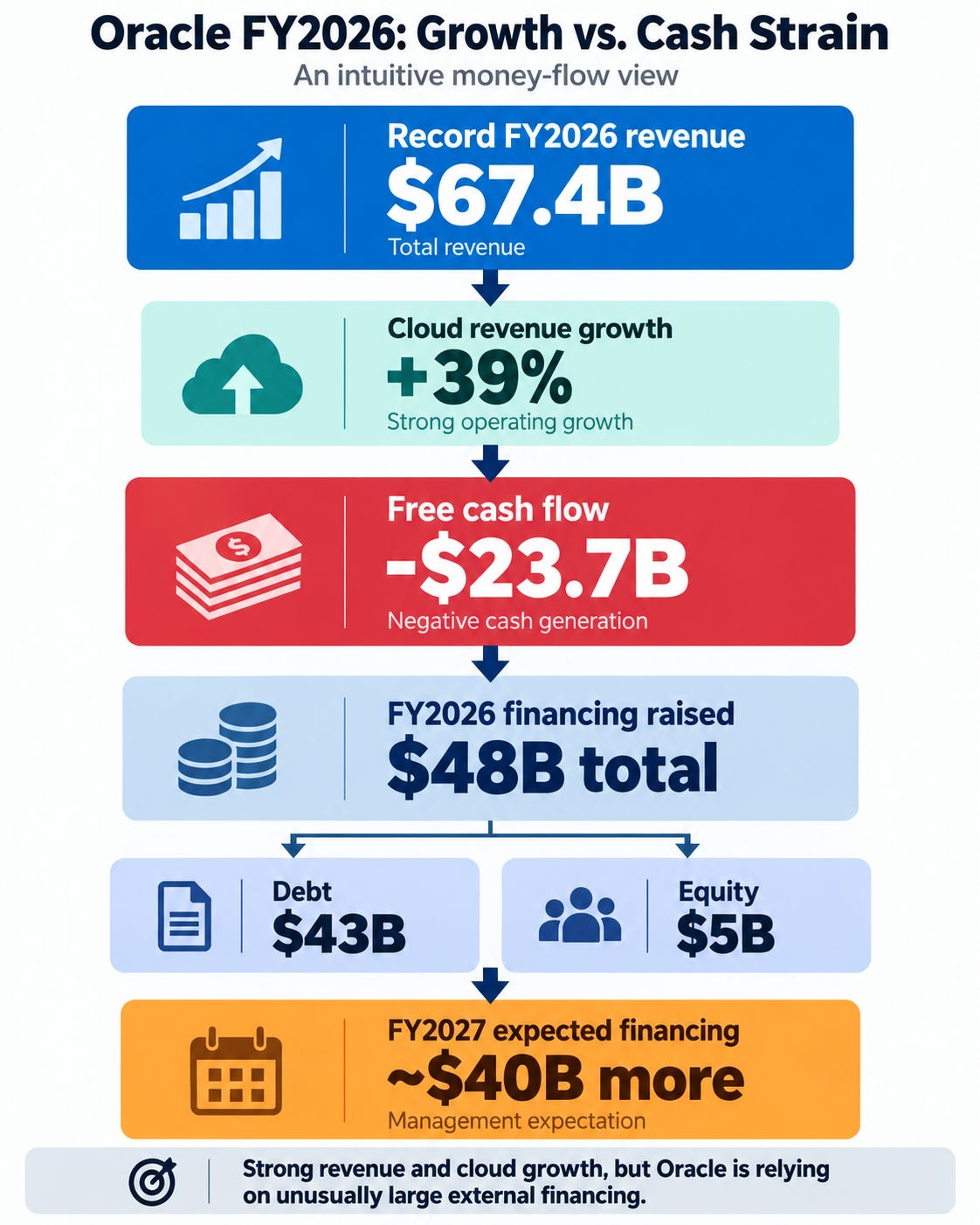
The deeper link is balance-sheet pressure. Oracle reported record FY2026 revenue of $67.4 billion with cloud revenue up 39%, but free cash flow was negative $23.7 billion. The company raised $43 billion in debt and $5 billion in equity during the year and expects roughly $40 billion more in FY2027. Against that, remaining performance obligations stood at $664 billion as of August 31, with about 13% expected to be recognized as revenue over the next twelve months.
That tension defines the bull and bear cases. Bulls see a contracted backlog that only needs to be delivered, with Jupiter as a local permitting problem. Bears see a company funding enormous capex with external capital, where each delayed site pushes out the cash flow meant to service the debt. Both can be partly right.
The episode shows how difficult it is to convert contracted AI demand into permitted, financeable physical capacity, and that challenge applies to every company building large-scale compute, regardless of which model developer is the end customer.
A bubble in the classic sense requires demand to collapse. What Jupiter shows is supply that cannot come online on the schedule its financing assumed. If that pattern repeats across multiple sites, the effect on lenders and shareholders could resemble a deflating bubble even if underlying demand holds.
What to Watch
November 23 air permit decision. The clearest near-term catalyst for Jupiter’s timeline.
New Mexico gubernatorial election in November. A moratorium would change the project’s risk profile materially.
A second force majeure notice. 24/7 Wall St. named a notice at another site, or a downward revision to Oracle’s $90 billion FY27 revenue commitment, as signals that would justify a more negative view.
Jupiter loan pricing and data center credit spreads. Stress in secondary loan markets has led equity sentiment so far.
Oracle’s free cash flow trajectory. Management has pointed to strong cash conversion once projects ramp but has not committed to a date for positive free cash flow.
Item 5 of the next 10-Q. This will show whether Ellison or other officers adopt new 10b5-1 plans. Any new Ellison plan would face a cooling-off period of at least 90 days.
Form 4 filings for Ellison. Transfers, gifts, pledges, or purchases would test the “no other plans to sell” statement.
The securities class action. If defendants move to dismiss the amended complaint, briefing is scheduled to finish by December 18, 2026.
Further equity issuance. The first ATM program is exhausted. A new one would signal continued reliance on equity to fund the build-out.
Pledged-share disclosures in the proxy statement. Shares pledged as loan collateral can create forced-sale risk independent of any trading plan.
This article is for informational purposes only and does not constitute investment advice. The author holds no position in the securities mentioned. Figures reflect filings and reporting as of September 26, 2026, and the situation is developing.